Thank you for reading this post, don't forget to subscribe!
Automation is not just about making welding faster. Instead, it is about making the entire welding process more controlled, repeatable, and structured.
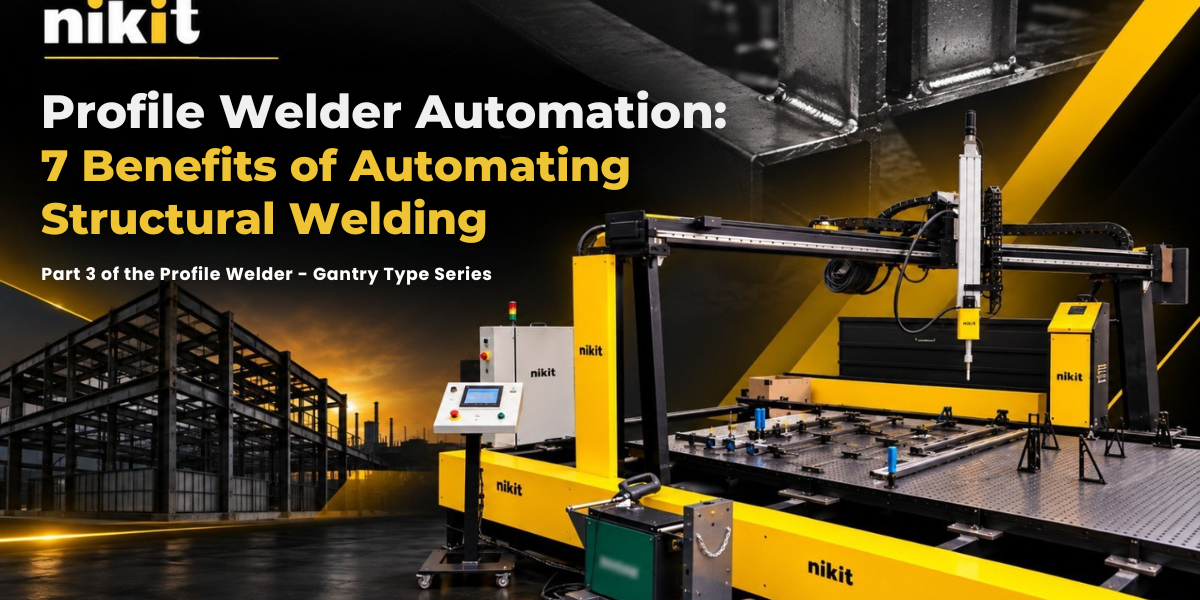
In Part 1, we explored how the Profile Welder – Gantry Type uses gantry architecture, multi-axis movement, and torch interpolation. In Part 2, we examined its applications across frames, structural assemblies, fuel tanks, racks, machine beds, truck bodies, and specialised industrial components.
Now, let’s explore the next important question: What are the benefits of Profile Welder automation, and what changes when structural welding becomes automated?
1. More Consistent Welding Movement
When welding becomes automated, the torch can follow a programmed path instead of relying entirely on manual movement.
With coordinated multi-axis motion and interpolation, the system can follow defined paths across different component geometries and joint locations. As a result, manufacturers can establish a more consistent welding process across production cycles.
This is especially important in structural welding, where components may contain multiple profiles, intersections, and joints at different positions. Therefore, the welding path must match the geometry of the component.
By controlling torch movement and defining the welding sequence, Profile Welder automation can help improve process consistency.
2. Improved Repeatability Across Production
Consistency in one welding cycle is valuable. However, maintaining that consistency across many components is equally important.
Consider a manufacturer producing the same structural component repeatedly. The objective is to reproduce the required welding sequence, torch positioning, and movement for every production cycle.
Programmed motion and defined sequences can help reduce variation between components. Consequently, manufacturers can establish a more repeatable process for recurring welding applications.
Although the final outcome still depends on component preparation, fixturing, welding parameters, and process validation, automation provides a structured foundation for repeatable production.
3. Better Productivity Beyond Welding Speed
Productivity involves more than how quickly a torch deposits weld metal. It also includes component positioning, torch movement, weld sequencing, repositioning, process interruptions, and production monitoring.
For example, manual welding of a complex structure may require repeated movement around the component. In contrast, a well-engineered gantry system can coordinate movement around defined welding locations.
As a result, manufacturers can evaluate how to reduce unnecessary movement and delays within the welding cycle.
The objective is not simply to increase welding speed. Instead, it is to create a more organised workflow that supports efficient production.
4. Greater Production Control
Automation also creates opportunities for better control over the welding sequence.
The Profile Welder incorporates features such as semi-sequence operation, pause/play functionality, smart weld-point selection, motor-load indication, interpolation-based motion control, and data logging and monitoring capabilities.
Together, these functions help operators manage machine movement and production activities more systematically.
Rather than treating every weld as an isolated operation, manufacturers can plan and manage the complete welding sequence. Furthermore, pause and play functions can support controlled program execution when operators need to review or manage a process.
This structured approach helps connect individual welding operations with the broader production workflow.
5. From Welding Automation to Data-Driven Automation
Modern welding automation is no longer only about motion. It is also about understanding production data.
Depending on the selected system configuration, the Profile Welder can integrate with MachineData.ai, the AI Weld Agent, gas-flow sensors, and AC/DC energy meters.
MachineData.ai can support real-time monitoring, centralised data visibility, and analysis of welding and machine-performance data. Consequently, manufacturers can gain a clearer view of machine activity and production performance.
This creates a connection between the physical welding process and the information generated during production.
Instead of asking only, “Did the machine complete the weld?”, manufacturers can also ask, “What happened during the welding cycle, and what can the production data tell us?”
That shift can support more informed production decisions.
6. Automation With Human Oversight
Automation does not mean removing people from the process. Rather, it allows the machine to handle controlled, repetitive movement while people focus on setup, supervision, inspection, process management, and production decisions.
This balance is particularly important in complex structural welding. Component geometry, joint preparation, welding parameters, and quality requirements still demand engineering knowledge.
Therefore, the objective is to combine machine repeatability with human expertise. Operators and engineers remain essential to validating the process, managing exceptions, and ensuring that the selected solution meets the application requirements.
7. Flexibility for Different Structural Components
A highly automated machine must still accommodate the requirements of the component.
That is why the Component + Torch Interpolation concept is important. The Profile Welder can be engineered around different component geometries, weld locations, joint configurations, welding paths, and production requirements.
For example, a large frame may require a different movement strategy from a fuel tank or machine bed. Similarly, changing joint locations may require a revised torch path and welding sequence.
Therefore, automation should be designed around the application rather than restricted to one fixed movement.
The greater opportunity is to coordinate the welding system around the complete component.
What Are the Main Benefits of Profile Welder Automation?
When these capabilities work together, Profile Welder automation can support:
- Greater welding consistency
- Improved repeatability across production cycles
- More structured welding sequences
- Better production control
- Reduced repetitive operator movement
- Greater visibility into machine and welding data
- Flexible automation for different structural components
However, the results depend on component design, fixturing, welding parameters, machine configuration, and process validation. For this reason, every application should be evaluated before selecting an automation solution.
FAQs
What are the main benefits of Profile Welder automation?
Profile Welder automation can support welding consistency, repeatability, structured production sequences, production control, coordinated multi-axis movement, and improved visibility into machine data. Actual results depend on the application and system configuration.
How can a Profile Welder improve welding consistency?
Programmed motion, controlled torch movement, interpolation, and defined welding sequences can help establish a more repeatable process across production cycles. Component preparation, fixturing, and welding parameters also influence the final result.
Can Profile Welder automation handle different structural components?
Yes. The system can be engineered around different component geometries, weld locations, joint configurations, welding paths, and production requirements. The appropriate configuration depends on the component and its welding application.