Thank you for reading this post, don't forget to subscribe!
Welding Automation Experience Center in Mexico | Nikit Engineers
Welding automation is becoming increasingly important for manufacturers looking to improve consistency, repeatability, productivity, and process control. But for many companies, choosing the right automation technology starts with one simple question: Can I see the machine working on a real production application?
Now, manufacturers in Mexico have the opportunity to experience advanced welding automation closer to their operations.
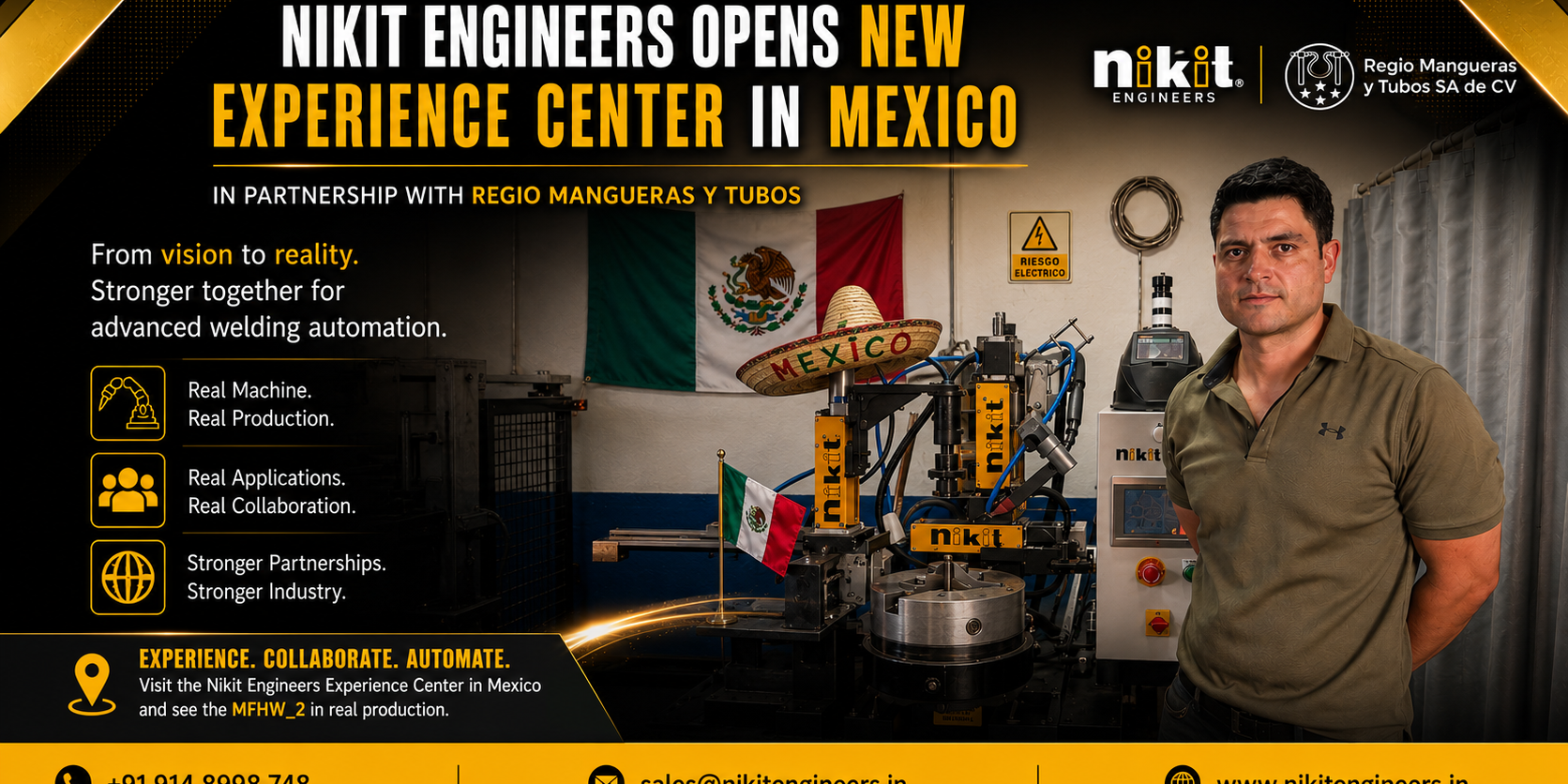
Nikit Engineers has established a Welding Automation Experience Center in Mexico in partnership with Regio Mangueras y Tubos in Monterrey, Nuevo León. At the center, manufacturers can explore the MFHW_2 — Mini Flexi Hose Welder V2, an automated welding solution focused primarily on flexible hose welding applications from 0–4 inches.
What makes this Experience Center different is that the machine is not simply positioned for demonstration. The MFHW_2 is also being used as part of Regio Mangueras y Tubos’ internal production system.
Real machine. Real production. Real application experience.
For manufacturers evaluating welding automation in Mexico, this creates an opportunity to see how automation can work in an actual industrial environment and discuss potential applications with an experienced technical partner.
What Is a Welding Automation Experience Center in Mexico?
A welding automation Experience Center is more than a showroom.
It is a practical environment where manufacturers, engineers, production managers, and automation professionals can see welding technology operating, understand its capabilities, discuss specific production requirements, and explore opportunities for automation.
Instead of evaluating a machine only through specifications, photographs, or videos, manufacturers can experience the equipment in operation.
A welding automation Experience Center can help companies better understand:
- How an automated welding process operates
- Where automation can improve process consistency
- How welding parameters can be standardized
- Whether a particular application is suitable for automation
- How a machine can fit into an existing production system
- What level of customization may be required
- How automation can support long-term manufacturing objectives
This practical approach can make the decision-making process more informed and application-focused.
Nikit Engineers and Regio Mangueras y Tubos Bring Welding Automation to Monterrey
The Mexico Experience Center brings together two complementary areas of industrial expertise.
Nikit Engineers develops and delivers welding automation, robotic welding, special-purpose machines, and customized industrial automation solutions.
Regio Mangueras y Tubos is based in Monterrey and has more than 30 years of experience providing hoses, connections, expansion joints, technical assistance, and related industrial solutions.
The partnership creates a strong environment for demonstrating flexible hose welding automation because the technology can be viewed alongside real-world hose manufacturing and production requirements.
For Mexican manufacturers, particularly those in and around Monterrey, this means advanced welding automation can be explored closer to the applications where it may ultimately be used.
MFHW_2 — Mini Flexi Hose Welder V2
One of the key technologies available at the Mexico Experience Center is the MFHW_2 — Mini Flexi Hose Welder V2.
The MFHW_2 is designed primarily for automated flexible hose welding applications, with a focus on hose sizes from 0–4 inches.
Flexible hose assemblies are used across many industrial applications where fluid flow, movement, vibration, thermal expansion, or connection flexibility are important considerations.
Producing these assemblies consistently requires controlled and repeatable welding processes.
This is where welding automation can provide significant value.
Flexible Hose Welding Applications from 0–4 Inches
The MFHW_2 is focused on applications involving flexible hoses within the 0–4 inch range.
Depending on the specific application, automated flexible hose welding can support the production of assemblies used in areas such as:
- Industrial fluid-flow systems
- Hydraulic applications
- Energy-related equipment
- Chemical processing
- Petrochemical applications
- Industrial machinery
- Manufacturing equipment
- Piping and connection systems
The suitability of an automated welding process ultimately depends on the component design, material, joint configuration, production requirements, and other application-specific factors.
That is why seeing the machine in operation and discussing the application with an engineering team can be valuable before making an automation decision.
Why Automate Flexible Hose Welding?
One of the most common questions manufacturers ask is:
Why should flexible hose welding be automated?
The answer depends on the production environment, but automation can help create a more controlled and repeatable welding process.
1. Improved Process Repeatability
Manual welding can introduce variation between operators and between individual components.
An automated system can help standardize the welding process and provide greater repeatability from one production cycle to the next.
2. Consistent Welding Parameters
Automation can help control important process parameters more consistently.
This can support a standardized production method, particularly when manufacturers produce repeated or similar assemblies.
3. Reduced Process Variation
Manufacturing environments benefit when unnecessary variation is reduced.
Automated welding can help create a more predictable process by controlling machine movements and programmed welding operations.
4. Improved Production Control
Automation provides manufacturers with greater control over how a welding operation is performed.
Instead of relying entirely on individual operator technique, the process can be engineered around defined production requirements.
5. Scalable Manufacturing
As production requirements grow, manufacturers may need processes that are easier to standardize and scale.
A properly engineered automated welding system can become part of a broader manufacturing strategy rather than functioning as an isolated machine.

A Welding Machine Already Used in Real Production
One of the strongest advantages of the Mexico Experience Center is the connection between demonstration and real production.
The MFHW_2 at Regio Mangueras y Tubos is being used as part of its internal production system.
This makes the Experience Center particularly valuable for manufacturers considering flexible hose welding automation.
Visitors are not simply looking at a machine sitting on a showroom floor.
They can see an automated welding solution being applied within a real industrial production environment.
Real Machine. Real Production. Real Application Experience.
For manufacturers, this distinction matters.
Seeing an automation system operating in production can provide a clearer understanding of:
- Machine operation
- Welding workflow
- Component handling
- Production considerations
- Operator interaction
- Process repeatability
- Potential automation opportunities
It also creates a better environment for technical discussions.
Instead of asking only, “What can the machine do?”, manufacturers can ask a more important question:
“How could this technology work for our production process?”
That is the purpose of an Experience Center.
FlowCore — Welding at the Core of Reliable Fluid Flow
The Mexico Experience Center also connects with Nikit Engineers’ broader FlowCore technology concept.
The idea behind FlowCore comes from a simple engineering principle: welding plays a critical role in manufacturing reliable components used for fluid flow.
FlowCore puts welding at the core of reliable fluid flow.
The concept is broadly divided into two areas:
Flexi Flow
Flexi Flow focuses on flexible fluid-flow applications, including:
- Flexible hose welding
- Stainless steel flexible hose assemblies
- Hose connections
- Flexible components used in industrial fluid systems
The MFHW_2 is closely aligned with this Flexi Flow application space.
Rigid Flow
Rigid Flow addresses applications involving more rigid piping and tube-based components.
These applications can involve:
- Piping assemblies
- Tube structures
- Rigid fluid-flow components
- Automated welding for piping applications
Together, Flexi Flow and Rigid Flow represent a broader approach to welding automation for fluid-flow manufacturing.
What Can Manufacturers Explore at the Mexico Experience Center?
The Experience Center provides an opportunity for manufacturers to explore welding automation from an application perspective.
Depending on their requirements, visitors can discuss:
- Flexible hose welding automation
- MFHW_2 applications
- Automated welding processes
- Production repeatability
- Welding process standardization
- Industrial hose applications
- Fluid-flow component manufacturing
- Production automation opportunities
- Customized welding automation
- Future automation requirements
The objective is not simply to demonstrate equipment.
It is to help manufacturers understand where automation can make sense within their production environment.
Who Can Benefit From a Welding Automation Experience Center?
A welding automation Experience Center can be particularly valuable for professionals involved in manufacturing and production decision-making.
This includes:
- Manufacturing engineers
- Welding engineers
- Automation engineers
- Production managers
- Plant managers
- Operations managers
- Industrial engineers
- Maintenance teams
- Manufacturing business owners
- Equipment manufacturers
- Hose manufacturers
- Hydraulic component manufacturers
- Industrial equipment suppliers
For companies that are already considering automation, an Experience Center can help move the discussion from a general concept toward a practical application.
Why Monterrey Is an Important Location for Welding Automation
Monterrey, Nuevo León, is an important industrial and manufacturing location in Mexico.
The region’s strong industrial ecosystem makes it a strategic location for connecting manufacturers with advanced production technologies.
Establishing a welding automation Experience Center in Monterrey allows manufacturers in the region to explore automation without relying exclusively on remote demonstrations.
It also creates a closer connection between technology providers and industrial users.
For companies evaluating welding automation in Mexico, proximity matters.
Manufacturers can discuss their applications, understand equipment capabilities, and explore potential solutions in a more practical setting.
From Global Automation Technology to Local Manufacturing Support
Nikit Engineers’ Experience Center approach reflects a broader objective: bringing advanced automation technology closer to manufacturers.
The journey extends from Peoria, Illinois, to Bengaluru, India, and now to Monterrey, Mexico.
Each location represents an opportunity to connect technology, engineering expertise, application knowledge, and manufacturing requirements.
The objective is not simply to expand geographically.
It is to create environments where manufacturers can interact with automation technology and explore solutions based on real production challenges.
For Mexican manufacturers, the Monterrey Experience Center provides another point of connection with Nikit Engineers’ broader welding automation capabilities.
Why Should Manufacturers See Welding Automation Before Investing?
Choosing an automated welding system is an important manufacturing decision.
A machine that works well for one application may not necessarily be the right solution for another.
That is why application evaluation is critical.
Visiting an Experience Center can help manufacturers understand:
Application Suitability
Companies can discuss component dimensions, materials, joint configurations, production requirements, and other factors that influence automation.
Process Requirements
Manufacturers can better understand how an automated welding process can be integrated into their production workflow.
Machine Operation
Seeing the equipment operating provides a more practical understanding than specifications alone.
Production Considerations
Manufacturers can discuss process consistency, operator involvement, production requirements, and future scalability.
Customization Opportunities
Some applications require specialized tooling, fixtures, machine configurations, or automation sequences.
Early technical discussions can help identify these requirements.
Ultimately, the goal is to ensure that automation is engineered around the application rather than forcing an application to fit a standard machine.
Welding Automation for the Future of Mexican Manufacturing
Manufacturing is continuously evolving.
Companies are looking for ways to improve consistency, increase process control, address production challenges, and build more scalable manufacturing systems.
Welding automation can contribute to these objectives when it is correctly engineered and matched to the application.
For Mexican manufacturers, the opportunity is not simply about purchasing a welding machine.
It is about asking:
Which welding processes should we automate?
Where can automation reduce process variation?
How can we create more repeatable production?
How can we prepare our manufacturing processes for future growth?
These questions are at the heart of modern manufacturing automation.
The best automation strategy begins with understanding the production process and identifying where technology can create measurable operational value.
From Global Automation Technology to Local Manufacturing Support
Nikit Engineers’ Experience Center approach reflects a broader objective: bringing advanced automation technology closer to manufacturers.
The journey extends from Peoria, Illinois, to Bengaluru, India, and now to Monterrey, Mexico.
Each location represents an opportunity to connect technology, engineering expertise, application knowledge, and manufacturing requirements.
The objective is not simply to expand geographically.
It is to create environments where manufacturers can interact with automation technology and explore solutions based on real production challenges.
For Mexican manufacturers, the Monterrey Experience Center provides another point of connection with Nikit Engineers’ broader welding automation capabilities.
Why Should Manufacturers See Welding Automation Before Investing?
Choosing an automated welding system is an important manufacturing decision.
A machine that works well for one application may not necessarily be the right solution for another.
That is why application evaluation is critical.
Visiting an Experience Center can help manufacturers understand:
Application Suitability
Companies can discuss component dimensions, materials, joint configurations, production requirements, and other factors that influence automation.
Process Requirements
Manufacturers can better understand how an automated welding process can be integrated into their production workflow.
Machine Operation
Seeing the equipment operating provides a more practical understanding than specifications alone.
Production Considerations
Manufacturers can discuss process consistency, operator involvement, production requirements, and future scalability.
Customization Opportunities
Some applications require specialized tooling, fixtures, machine configurations, or automation sequences.
Early technical discussions can help identify these requirements.
Ultimately, the goal is to ensure that automation is engineered around the application rather than forcing an application to fit a standard machine.
Welding Automation for the Future of Mexican Manufacturing
Manufacturing is continuously evolving.
Companies are looking for ways to improve consistency, increase process control, address production challenges, and build more scalable manufacturing systems.
Welding automation can contribute to these objectives when it is correctly engineered and matched to the application.
For Mexican manufacturers, the opportunity is not simply about purchasing a welding machine.
It is about asking:
Which welding processes should we automate?
Where can automation reduce process variation?
How can we create more repeatable production?
How can we prepare our manufacturing processes for future growth?
These questions are at the heart of modern manufacturing automation.
The best automation strategy begins with understanding the production process and identifying where technology can create measurable operational value.
Explore Welding Automation in Mexico With Nikit Engineers
The future of manufacturing automation is not only about advanced machines. It is about applying the right technology to the right production challenge.
The Nikit Engineers Welding Automation Experience Center in Mexico, established with Regio Mangueras y Tubos in Monterrey, gives manufacturers an opportunity to explore this approach firsthand.
With the MFHW_2 Mini Flexi Hose Welder V2 operating in a real production environment, manufacturers can see how flexible hose welding automation can be applied, discuss their own production requirements, and explore potential opportunities for automation.
Whether you are looking to automate a single welding operation or develop a broader manufacturing automation system, Nikit Engineers works closely with customers to engineer solutions around their production requirements.
From flexible hose welding and rigid piping solutions to robotic welding, Special Purpose Machines, structural automation, and AI-powered machine monitoring, our objective is to help manufacturers improve productivity, consistency, quality, and operational efficiency.
Ready to Explore Advanced Welding Automation?
Connect with Nikit Engineers to discuss your welding automation requirements and explore how our technologies can support your manufacturing process.
Sales Enquiries
📧 sales@nikitengineers.in
International & Export Enquiries
📧 pradeep@nikitengineers.in
Nikit Engineers — Engineering Automation. Enabling Innovation. Building the Future.
In conclusion, with Nikit Engineers Welding Automation and Robotic Solutions, the future of semiconductor manufacturing is brighter than ever. Our commitment to excellence, precision, and efficiency ensures that manufacturers stay ahead of the curve in this dynamic industry. Experience the future with Nikit Engineers – where innovation meets craftsmanship.
Contact us today to schedule your Free Weld Trial Services and unlock the potential of automation in profile welding.
Nikit Engineers’ Robotic Welding Automation Solutions proudly declare that all our products are #MADEININDIA
Check out our other industrial ventures www.thewelder.in and www.civilautomation.com
Don’t forget to subscribe to our YouTube Channel for the latest videos and updates – www.youtube.com/@Nikitengineers
FAQs
Where can I see welding automation in Mexico?
Nikit Engineers’ Welding Automation Experience Center in Mexico is established with Regio Mangueras y Tubos in Monterrey, Nuevo León. The center provides an opportunity to explore welding automation technology and see the MFHW_2 Mini Flexi Hose Welder V2 operating in a production environment.
What is the MFHW_2 welding machine?
The MFHW_2, or Mini Flexi Hose Welder V2, is an automated welding solution developed primarily for flexible hose welding applications.
What size hoses can the MFHW_2 weld?
The MFHW_2 is focused primarily on flexible hose welding applications from 0–4 inches.
Can I see a flexible hose welding machine operating in Mexico?
Yes. The MFHW_2 is available at the Nikit Engineers Experience Center established with Regio Mangueras y Tubos in Monterrey, where the machine is also being used as part of the company’s internal production system.
Why is flexible hose welding automation important?
Flexible hose welding automation can help manufacturers achieve greater process repeatability, consistency, process control, and production standardization. The exact benefits depend on the application and production requirements.