Thank you for reading this post, don't forget to subscribe!
Manufacturers today operate in an increasingly competitive environment where productivity, quality, and cost efficiency determine long-term success. Whether producing automotive components, pressure vessels, pipelines, agricultural equipment, or industrial machinery, one challenge remains constant—achieving consistent, high-quality welds while meeting demanding production schedules.
Unfortunately, many manufacturers continue to face recurring welding challenges that slow production, increase costs, and impact product quality. Manual welding processes often struggle to deliver the consistency and speed required for modern manufacturing, especially as skilled labor shortages continue to grow and customer quality expectations become more stringent. Industry experts also note that automation is becoming a key driver of productivity, quality, and workforce efficiency across manufacturing.
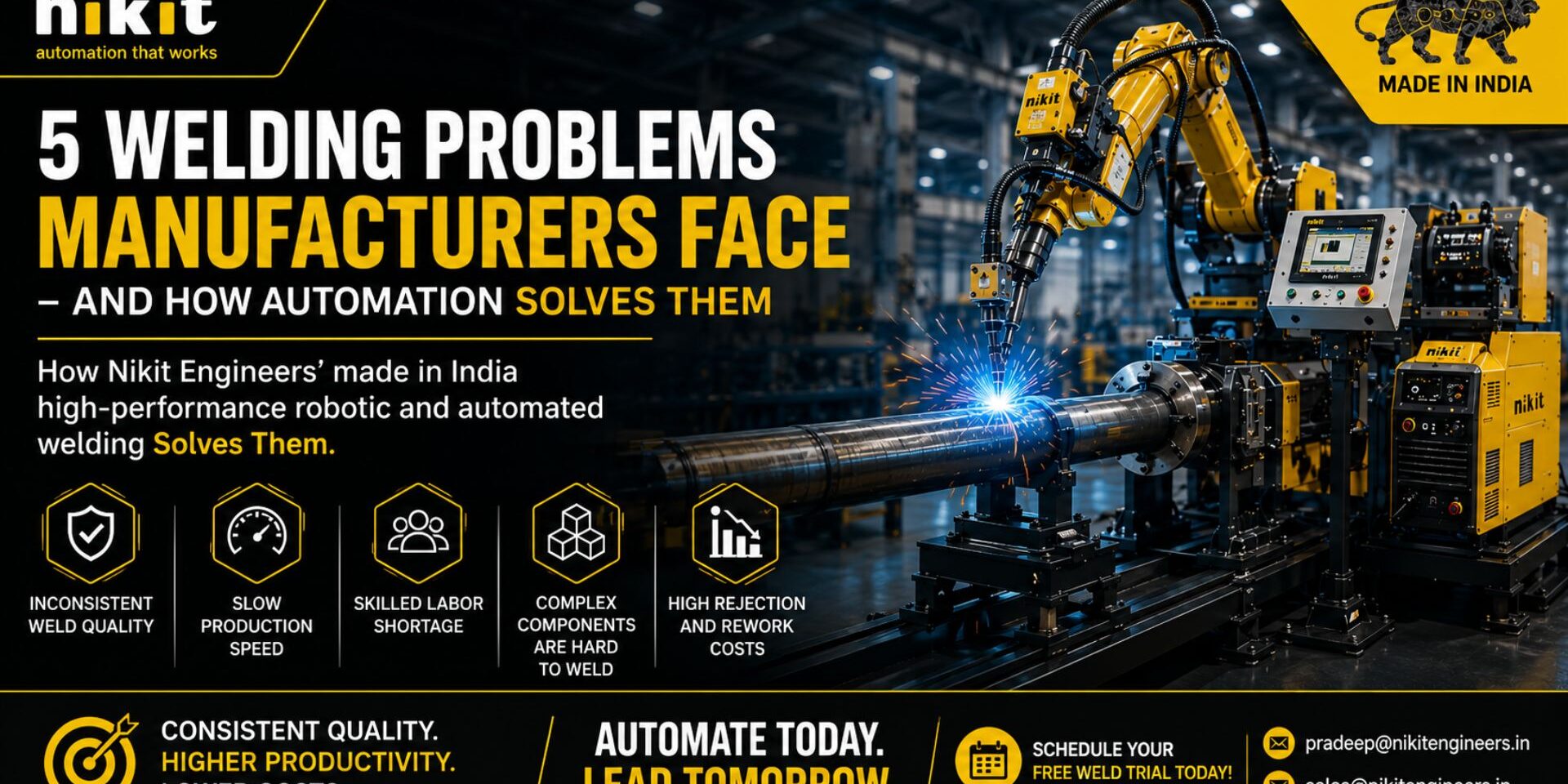
This is where How Nikit Engineers’ made in India high-performance robotic and automated welding Solves Them becomes a game-changing solution. By combining advanced welding automation with precision engineering, manufacturers can improve productivity, reduce rework, and achieve repeatable weld quality across every production cycle.
Let’s explore the Welding Problems Manufacturers Face and how automation provides the solution.
1. Inconsistent Weld Quality
One of the most common Welding Problems Manufacturers Face is inconsistent weld quality.
Manual welding depends heavily on operator skill, experience, concentration, and physical endurance. Even highly skilled welders may produce slight variations in torch angle, travel speed, heat input, and filler material, resulting in inconsistent welds across production batches.
These inconsistencies often lead to:
- Weld defects
- Poor bead appearance
- Dimensional variations
- Increased rejection rates
- Costly repairs and rework
How Automation Solves It
Nikit Engineers’ robotic and automated welding systems maintain precise welding parameters throughout every cycle.
Automated systems provide:
- Constant heat input
- Uniform travel speed
- Controlled wire feeding
- Precision torch positioning
- Repeatable weld cycles
The result is identical weld quality from the first component to the last, helping manufacturers improve product reliability and customer satisfaction.
2. Slow Production Speed
As customer demand increases, manufacturers often struggle to scale production using manual welding alone.
Manual welding involves multiple handling operations, frequent setup changes, and operator fatigue, all of which reduce throughput and extend production cycles.
How Automation Solves It
How Nikit Engineers’ made in India high-performance robotic and automated welding Solves Them is by significantly improving production efficiency.
Solutions such as Circular Welders, Orbital Welders, Robotic Welding Systems, and customized automation cells enable manufacturers to produce components faster while maintaining consistent quality.
Benefits include:
- Faster welding cycles
- Continuous production
- Reduced idle time
- Higher machine utilization
- Increased production capacity
Automation enables manufacturers to meet tight delivery schedules without sacrificing weld quality.
3. Skilled Welder Shortages
Finding experienced welders has become one of the biggest challenges facing manufacturers worldwide.
As experienced professionals retire and demand continues to grow, companies often struggle to recruit and retain skilled welding personnel. The shortage has accelerated investment in robotic welding and automation across the manufacturing industry.
How Automation Solves It
Automation reduces dependence on highly specialized manual welding while allowing skilled operators to supervise multiple systems.
Nikit Engineers’ automated welding solutions feature user-friendly controls that simplify operation and improve production efficiency.
Instead of relying entirely on manual expertise, manufacturers can:
- Simplify welding operations
- Reduce operator fatigue
- Improve workforce productivity
- Optimize skilled labor utilization
- Maintain consistent output
Automation complements skilled welders by allowing them to focus on higher-value tasks rather than repetitive production welding.
4. Complex Components Are Difficult to Weld
Modern manufacturing often involves welding components with challenging geometries, including curved pipes, cylinders, bent tubes, structural profiles, and customized assemblies.
Maintaining consistent weld quality across these components using manual methods can be difficult.
How Automation Solves It
Nikit Engineers develops advanced welding automation systems capable of handling complex fabrication requirements with exceptional precision.
Features include:
- Multi-axis movement
- Precision torch positioning
- Accurate pipe and profile rotation
- Controlled welding parameters
- Repeatable positioning for complex parts
Whether welding cylindrical components, pipe spools, profiles, or specialized industrial assemblies, automation helps manufacturers achieve reliable and repeatable results.
5. High Rejection and Rework Costs
Poor weld quality directly affects profitability.
Rejected components require additional inspection, repair, material replacement, and labor, increasing overall production costs while delaying deliveries.
How Automation Solves It
Robotic and automated welding minimizes production variability by maintaining consistent welding parameters throughout every cycle.
Manufacturers benefit from:
- Lower rejection rates
- Reduced material waste
- Less rework
- Faster quality inspections
- Improved first-pass yield
- Better return on investment
The result is a more efficient manufacturing process that reduces overall operating costs while improving product quality.
Why Choose Nikit Engineers?
How Nikit Engineers’ made in India high-performance robotic and automated welding Solves Them goes beyond simply replacing manual welding.
Our automation solutions are designed to help manufacturers achieve:
- Consistent weld quality
- Higher productivity
- Faster production cycles
- Lower manufacturing costs
- Improved process control
- Enhanced product reliability
- Scalable production capabilities
As a trusted Indian manufacturer of welding automation solutions, Nikit Engineers supports industries including automotive, construction equipment, industrial fabrication, pressure vessels, pipelines, HVAC, heavy engineering, and infrastructure.
Conclusion
The most common Welding Problems Manufacturers Face—inconsistent quality, slow production, labor shortages, complex welds, and high rework costs—can significantly impact manufacturing performance.
Modern welding automation provides a smarter, more reliable solution.
By investing in Nikit Engineers’ made in India high-performance robotic and automated welding solutions, manufacturers can improve efficiency, enhance weld quality, reduce production costs, and remain competitive in today’s rapidly evolving manufacturing landscape.
Automation isn’t replacing skilled welders—it’s empowering manufacturers to produce better products, faster and more consistently.
FAQs
What are the most common welding problems manufacturers face?
Manufacturers commonly face inconsistent weld quality, slow production speeds, skilled labor shortages, difficulties welding complex components, and high rejection or rework costs. Welding automation helps address each of these challenges by improving precision and consistency.
How does welding automation improve weld quality?
Automated welding systems maintain consistent heat input, torch position, travel speed, and wire feeding throughout every weld. This minimizes human variation and produces repeatable, high-quality welds.
Can robotic welding help solve the skilled labor shortage?
Yes. Robotic and automated welding reduces dependence on manual welding for repetitive tasks, allowing skilled welders to supervise automated systems, improve productivity, and focus on more complex fabrication work.
Which industries benefit from Nikit Engineers' automated welding solutions?
Nikit Engineers serves a wide range of industries, including automotive, industrial fabrication, pipe manufacturing, pressure vessels, heavy engineering, HVAC, construction equipment, infrastructure, and process industries.