
Thank you for reading this post, don't forget to subscribe!
Pipe spool welding may look like a straightforward process. A pipe is positioned, rotated and welded along its joint. However, automating this operation involves much more than rotating a pipe and moving a welding torch.
In real fabrication environments, every application can bring different requirements. Pipe dimensions may vary, joint fit-up may not always be identical, and the welding torch must maintain the correct position throughout the operation. At the same time, pipe rotation, welding movement and process parameters need to work together.
This is what makes pipe spool welding automation an engineering challenge.
For manufacturers, successful automation is not simply about making the welding process automatic. It is about developing a coordinated system that addresses the actual component, joint configuration, welding process and production requirements.
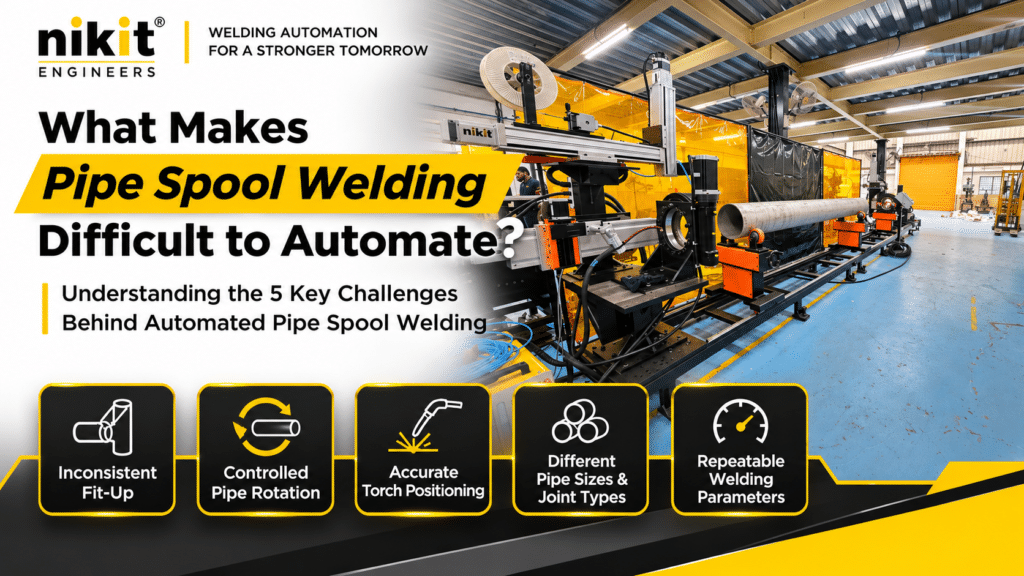
At Nikit Engineers, we approach pipe spool welding automation by considering these requirements together. Here are five important challenges that manufacturers should understand.
1. Inconsistent Joint Fit-Up: Every Joint Can Be Different
One of the first challenges in automated pipe spool welding is joint fit-up.
In actual fabrication environments, pipe alignment, joint gaps and edge preparation can vary from one component to another. Even when manufacturers work with similar pipe dimensions, small differences in fit-up can influence torch positioning and welding conditions.
This creates an important question: how can an automated welding process remain controlled when the joint itself is not always identical?
The answer begins with understanding the fabrication process.
Successful automation requires suitable component preparation, appropriate fixtures and a clear understanding of acceptable fit-up variations. The system must be planned around the conditions in which the manufacturer actually works.
Assuming that every pipe joint will be identical can create limitations during automation planning. Therefore, fit-up requirements should be considered from the beginning of the project.
2. Controlled Pipe Rotation: Why Synchronisation Matters
Pipe rotation is another critical factor in automated pipe spool welding.
As the pipe rotates, the welding process must maintain a coordinated relationship between rotational movement and torch travel. Both movements need to work together to support the required welding conditions throughout the cycle.
If pipe rotation becomes inconsistent, variations in travel speed and weld positioning can occur. Different pipe diameters and welding requirements may also call for different rotational speeds.
This is why controlled rotation matters.
The objective is to achieve smooth, coordinated movement so that the rotating component and welding torch work together as intended. The machine configuration must account for the component and the requirements of the selected welding application.
In other words, rotating the pipe is only one part of the operation. Maintaining the correct relationship between rotation and welding movement is equally important.
3. Accurate Torch Positioning: Small Changes Matter
Torch positioning has a direct influence on the welding operation. The torch angle, distance from the workpiece and alignment with the joint must remain controlled throughout the process.
Pipe geometry adds another layer of complexity. As the pipe rotates, the relationship between the torch and the joint changes. The system must maintain appropriate positioning for the selected welding position and process.
This means automated pipe spool welding requires more than rotational movement. Accurate torch positioning and coordinated machine-axis movement must also be considered.
The machine needs to be configured around the joint location, component geometry and required welding path.
When planning automation, manufacturers should therefore evaluate torch accessibility and movement alongside pipe rotation. Considering these requirements together helps develop a system suited to the actual welding application.
4. Different Pipe Sizes and Joint Types: Flexibility Is Essential
Pipe spool fabrication rarely involves just one component configuration.
Pipe diameter, wall thickness and length can change depending on the application. Joint configurations can also differ. For example, pipe-to-pipe joints and pipe-to-flange joints may require different welding approaches and setups.
An automation system must therefore be engineered around the range of components it is expected to handle.
Machine configuration, adjustable supports, suitable fixtures and programming flexibility become important considerations. The objective is to accommodate the required component geometry and welding operations rather than force different applications into one limited setup.
At Nikit Engineers, pipe spool welding solutions are developed with different fabrication requirements in mind. The appropriate configuration depends on the pipe dimensions, joint geometry, welding process and production requirements.
This application-led approach helps manufacturers evaluate what their automation system needs to achieve before finalising the machine configuration.
5. Repeatable Welding Parameters: Process Control Is Critical
Accurate mechanical movement alone does not guarantee a controlled welding process.
Parameters such as welding current, voltage, shielding gas flow and, where applicable, wire feed must remain controlled throughout the welding operation. Unexpected variations in these parameters can influence the resulting weld.
For this reason, automated pipe spool welding must consider both machine movement and welding-process control.
The welding power source, wire feeding arrangement, gas supply and selected welding procedure need to work together. Monitoring relevant machine and welding data can also help manufacturers understand production conditions and identify process variations.
This is an important distinction: welding automation is not just about controlling where the torch moves. It is also about considering the conditions under which welding takes place.
A well-planned system brings mechanical movement and welding-process requirements into one coordinated approach.
How Nikit Engineers Approaches Pipe Spool Welding Automation
The five challenges discussed above show why pipe spool welding needs an integrated engineering approach.
At Nikit Engineers, our Pipe Spool Welder solutions, including the Mini Pipe Spool Welder offering, are developed around practical pipe fabrication requirements.
Depending on the application and selected configuration, the system can incorporate:
- Controlled pipe rotation
- Coordinated torch movement
- Interpolation capabilities
- Welding-process integration
- Dual welding heads for root and follow-up passes, where required
Depending on the selected configuration, welding processes such as GMAW, GTAW, PAW, SAW and FCAW can be supported.
The objective is to bring component handling, rotational movement, torch positioning and welding operations into a coordinated system.
There is no single configuration that suits every pipe spool application. The right solution depends on pipe dimensions, component geometry, joint requirements, welding procedures and production needs.
That is why understanding the application is an essential first step in developing a suitable automation solution.
The Bigger Picture: Automating the Complete Welding Process
The five challenges of pipe spool welding automation are closely connected.
Inconsistent fit-up can affect torch positioning. Pipe rotation influences welding movement. Component geometry affects accessibility. Meanwhile, welding parameters influence process consistency.
Addressing each factor separately is not enough. They must be considered as parts of the same manufacturing process.
At Nikit Engineers, we believe welding automation should be engineered around real production requirements, not simply around machine movement.
The goal is not just to automate a weld. It is to create a more controlled and repeatable pipe spool welding process.
FAQs
Why is pipe spool welding difficult to automate?
Pipe spool welding involves several variables, including joint fit-up, pipe rotation, torch positioning, component dimensions, joint types and welding parameters. These factors must work together to support a controlled welding process.
Why is controlled pipe rotation important in automated pipe welding?
Controlled rotation helps maintain the required relationship between pipe movement and welding travel. It supports coordinated torch movement and helps maintain the intended welding conditions throughout the joint.
What should manufacturers consider before automating pipe spool welding?
Manufacturers should evaluate pipe dimensions, component weight, joint configuration, welding process, torch positioning, rotational control and production requirements. These factors help determine the appropriate machine configuration.