
Thank you for reading this post, don't forget to subscribe!
What Is a Profile Welder – Gantry Type?
What happens when welding automation moves beyond a single seam and starts addressing the complete structure?
This is where the Profile Welder – Gantry Type comes into the picture.
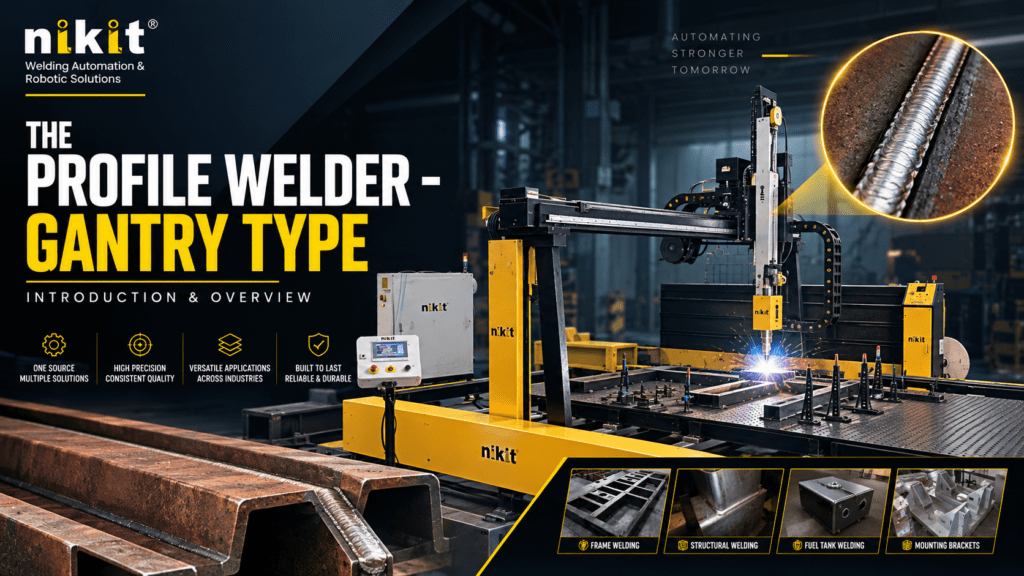
As part of Nikit Engineers’ Structural Series, the Profile Welder – Gantry Type is engineered for automated welding of large and complex fabricated components. It combines multi-axis motion, controlled torch movement, flexible fixturing, and welding process integration to create a structured approach to profile and structural welding.
The concept is simple:
Component + Torch Interpolation.
Instead of restricting automation to one fixed welding motion, the system coordinates torch and component movement to reach different joints, profiles, angles, and welding positions within the same production setup.
This approach makes the Profile Welder suitable for manufacturers working with complex structures where welding paths can vary significantly from one component to another.
How Does a Gantry-Type Profile Welder Work?
The Profile Welder uses a gantry-based architecture designed for large working envelopes and complex welding requirements.
Depending on the machine configuration, its motion system can coordinate multiple axes, including X, Y, Z, and rotary movement. This coordinated movement allows the welding torch to follow different profiles and reach multiple weld locations with controlled motion.
The system supports TIG and MIG welding processes and can handle different joint configurations, including:
- Lap joints
- Butt joints
- T-joints
- Corner joints
- Multiple-pass welding
It can also support weaving, oscillation, and interpolation-based motion control. Therefore, the machine can adapt its welding path to different component geometries instead of relying on one fixed movement.
Built for Large and Complex Structures
Large fabricated components often contain multiple profiles, intersections, corners, and weld locations. Moving these components between several machines can increase handling requirements, setup time, and production complexity.
The gantry concept addresses this challenge by providing a large working envelope around the component.
The configuration presented supports a working envelope of up to 16 m × 4 m × 1.5 m, with application-specific machine configurations available.
This makes the platform suitable for large structural components such as:
- Frames
- Structural assemblies
- Machine beds
- Truck bodies
- Fuel tanks
- Racks
- Fixtures
- Mounting brackets
- Similar fabricated structures
The objective is not simply to make the welding machine larger. It is to create an automation platform capable of working around the geometry and welding requirements of the component.
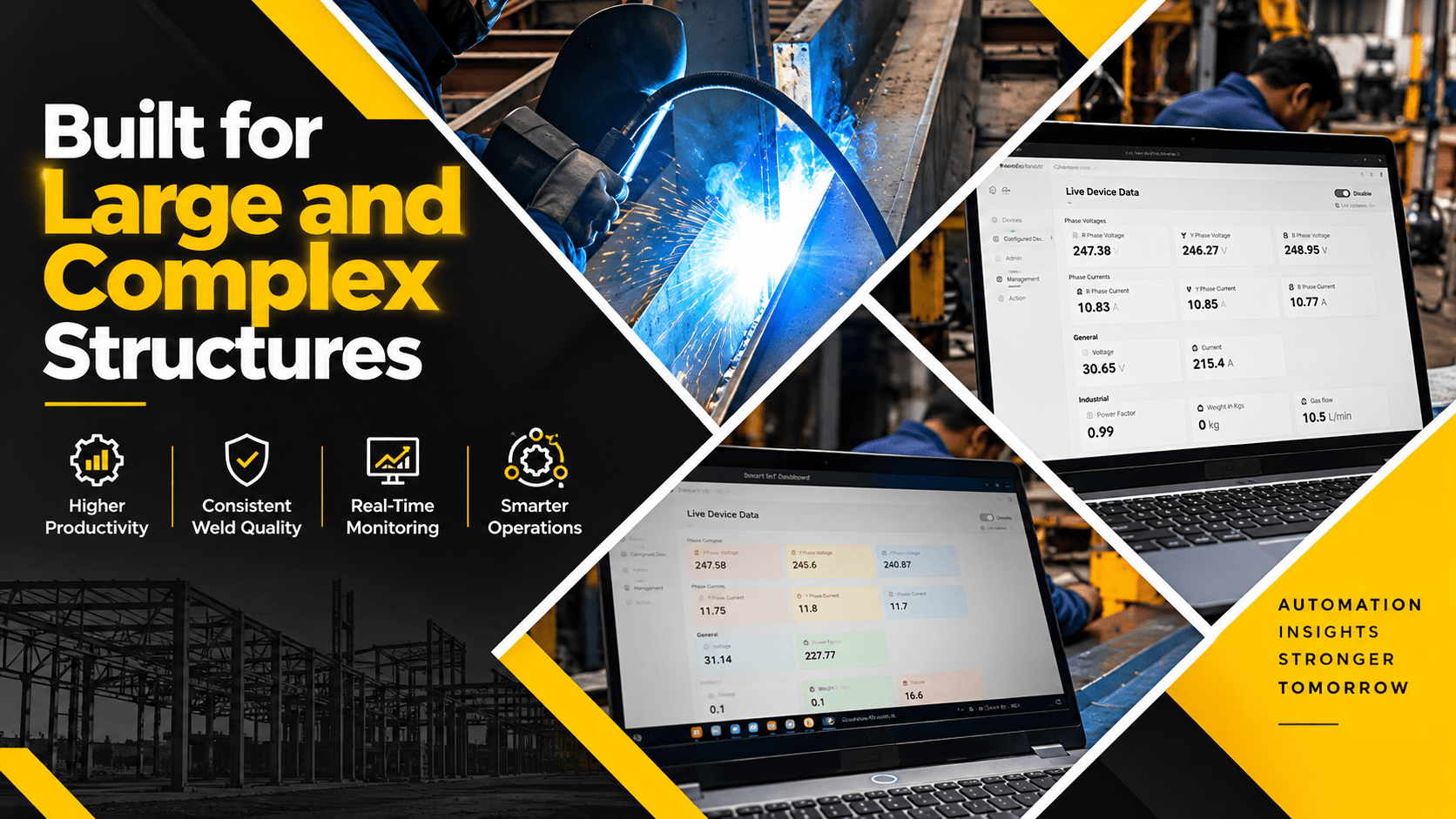
Nikit Engineer’s Profile Welder in Action

Key Features of the Profile Welder – Gantry Type
The Profile Welder is designed around controlled and flexible operation.
Key features include:
- On-the-fly mode: 30 mm
- Weaving and oscillation functions
- Semi-sequence operation
- Pause/play mode for controlled program execution
- Motor load indication
- Absolute homing without a sensor
- Interpolation-based motion control
- Smart weld-point selection
Together, these functions provide greater control over machine movement and weld execution.
For operators, this creates a practical automation environment. The machine provides control over welding sequences, motion, and process status. As a result, production teams can work with repeatable programs while retaining flexibility for different structures, joint locations, and production requirements.
Multi-Axis Motion for Complex Welding Paths
One of the important capabilities of a gantry-type profile welding system is coordinated motion.
A structural component may include multiple weld points positioned at different angles, surfaces, or locations. A conventional fixed welding movement may not be sufficient for such applications.
Interpolation allows the machine to coordinate movement across different axes and profiles.
This can help the welding torch follow more complex paths while maintaining controlled movement around the component.
The combination of multi-axis motion, weaving, oscillation, and interpolation creates a more flexible platform for structural welding automation.
Smart Features for Production Automation
Automation becomes more valuable when the machine can support operators during both programming and production.
Smart weld-point selection can simplify the process of identifying required weld locations. Meanwhile, interpolation enables coordinated movement across different axes and profiles.
Pause/play and semi-sequence modes can also support step-by-step process control, troubleshooting, and production verification.
These features help create a more structured production environment while allowing manufacturers to manage different component geometries and welding requirements.
MachineData.ai and AI Weld Agent for Welding Automation
The Profile Welder is also integrated with MachineData.ai and its AI Weld Agent, connecting welding operations with real-time machine data and analytics.
The system can collect and analyze important process information through integrated devices such as:
- Gas flow sensor
- AC energy meter
- DC energy meter
MachineData.ai can support real-time monitoring, anomaly detection, predictive maintenance, performance optimization, and centralized data visibility.
In practical terms, this creates an opportunity to move beyond simply operating a welding machine toward understanding what is happening within the production process.
This can provide a stronger foundation for production monitoring, maintenance planning, energy visibility, and data-driven decision-making.
Applications Across Multiple Industries
The Profile Welder – Gantry Type is designed for applications across industrial manufacturing, aerospace, defence, and earth-moving equipment manufacturing.
Its application range can include:
- Frame welding
- Structural welding
- Rebar welding
- Cycle frames
- Fuel tanks
- Rack welding
- Fixture welding
- Stator welding
- Truck bodies
- Machine beds
- Mounting brackets
The real value, however, is not simply the number of applications.
It is the ability to engineer one automation platform around different structural welding requirements.
Why Structural Welding Automation Needs a Complete-System Approach
Structural welding involves more than depositing weld metal.
Component geometry, joint locations, welding positions, motion control, torch access, welding parameters, fixturing, and production sequence all influence the final result.
That is why a complete automation approach is important.
The Profile Welder – Gantry Type brings these elements together through a combination of gantry architecture, multi-axis motion, interpolation, welding process integration, and production monitoring capabilities.
For manufacturers handling large and complex fabricated structures, this approach can provide a more flexible foundation for welding automation.
FAQs
What is a Profile Welder – Gantry Type?
A Profile Welder – Gantry Type is an automated structural welding system designed for large and complex fabricated components. It uses gantry-based multi-axis motion, controlled torch movement, and interpolation to reach different weld joints, profiles, angles, and welding positions within a production setup.
What applications can a Profile Welder – Gantry Type handle?
The Profile Welder – Gantry Type can be used for applications such as frame welding, structural welding, rebar welding, cycle frames, fuel tanks, racks, fixtures, stators, truck bodies, machine beds, and mounting brackets. It is designed for industrial manufacturing, aerospace, defence, and earth-moving equipment manufacturing applications.
What makes a gantry-type profile welder suitable for large structures?
A gantry-type profile welder provides a large working envelope and coordinated multi-axis movement around the component. The presented configuration supports a working envelope of up to 16 m × 4 m × 1.5 m. This allows manufacturers to automate welding across large structures with multiple profiles, joints, angles, and weld locations.
Can I see a flexible hose welding machine operating in Mexico?
Yes. The MFHW_2 is available at the Nikit Engineers Experience Center established with Regio Mangueras y Tubos in Monterrey, where the machine is also being used as part of the company’s internal production system.
Why is flexible hose welding automation important?
Flexible hose welding automation can help manufacturers achieve greater process repeatability, consistency, process control, and production standardization. The exact benefits depend on the application and production requirements.